Why Circuit Breakers and Distribution Panels Fail in Bothell Homes
A circuit breaker serves one fundamental purpose: to shut off power when electricity flowing through a branch exceeds the safe carrying capacity of the copper wire, or when a short circuit occurs. When a breaker trips repeatedly, it is either actively protecting your home from an unsafe overcurrent, or the breaker's internal thermal-magnetic trip mechanism has fatigued from age, heat, or repeated mechanical tripping cycles.
In Bothell neighborhoods established between 1955 and 1980—such as Norway Hill, Maywood, Beckstrom Hill, and Pioneer Hills—hundreds of homes still have original Federal Pacific Electric (FPE) Stab-Lok or Zinsco electrical panels. Independent testing by electrical safety laboratories has shown that FPE Stab-Lok breakers fail to trip in a substantial percentage of overcurrent events, remaining energized even while wires overheat inside walls. Zinsco panels suffer from an aluminum bus bar design where breakers vibrate loose, arc, and weld directly to the metal bus bar.
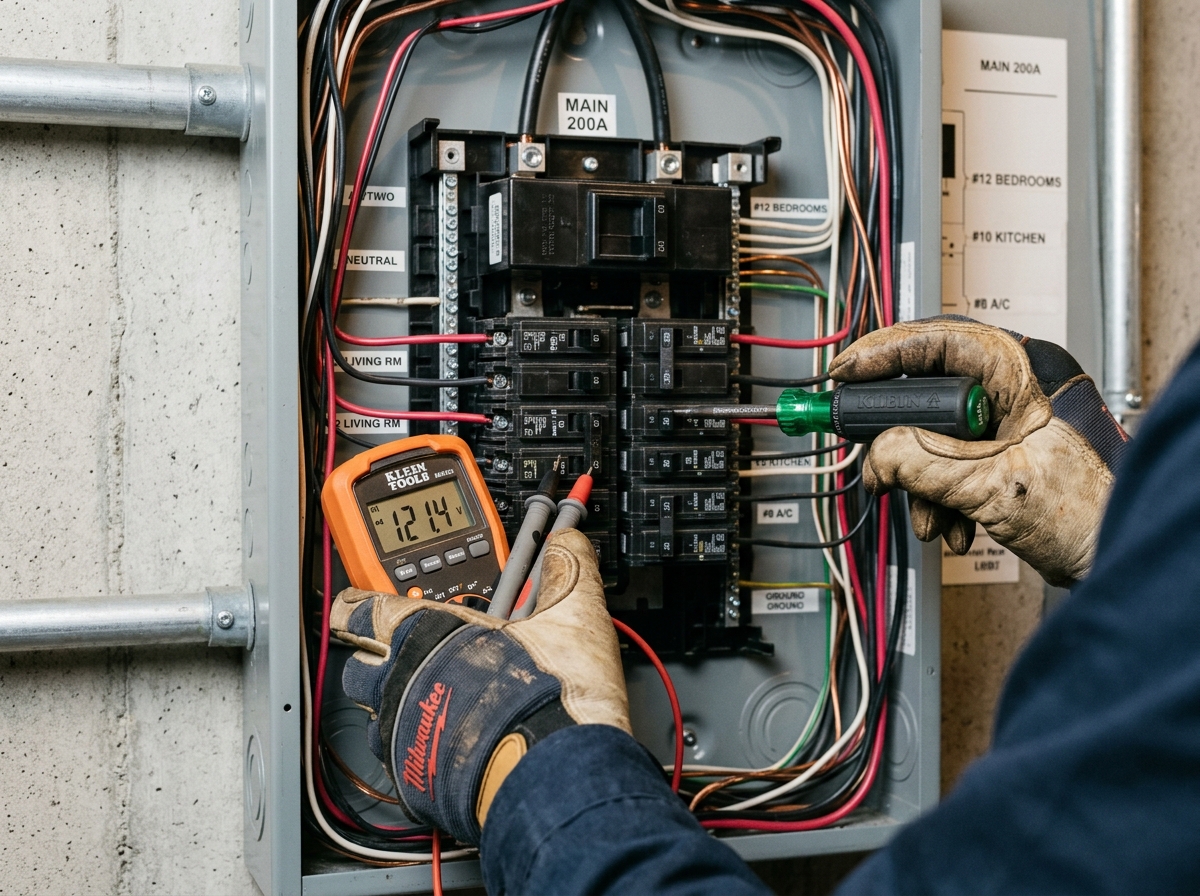
Furthermore, older Bothell homes were wired when household electrical demand peaked at 60 to 100 amps—sufficient for a refrigerator, television, and incandescent lighting. Today, adding an electric vehicle charger, a ductless mini-split heat pump, an induction range, and home office computers pushes these vintage panels well past their thermal safety thresholds. We test your panel's true total load, inspect bus bar integrity, and provide permanent solutions.